
Your old asphalt or clay tennis court may be ready for replacement. The landscaping, stone walls, fencing, and patio around it probably aren’t.
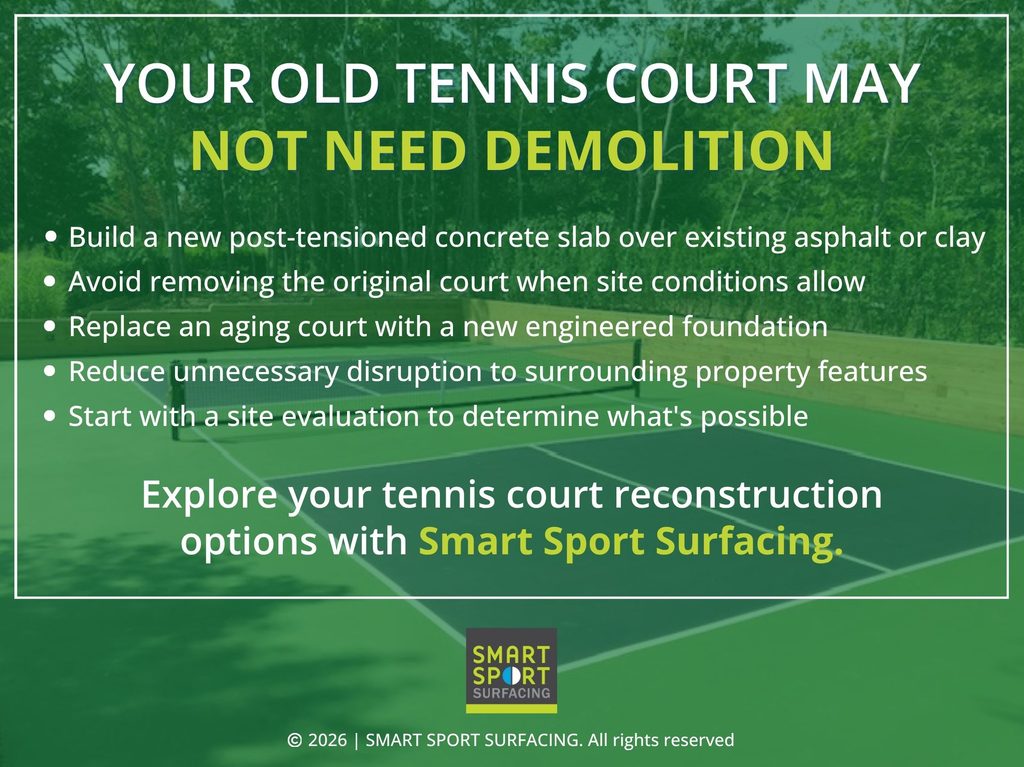
Here’s something many homeowners don’t realize: a new post-tensioned concrete tennis court can be built directly over an existing asphalt or clay court, without tearing out the old asphalt or removing the clay.
At Smart Sport Surfacing, we use this tennis court reconstruction method on established properties in the Hamptons. Rather than dismantling the original court and disturbing everything around it, we leave the existing asphalt or clay in place beneath a new engineered concrete slab.
For homeowners in East Hampton, Southampton, and surrounding communities, this can make a remarkable difference in how a court reconstruction is planned and carried out.
Tennis Court Renovation Without Removing the Existing Asphalt or Clay
If you’ve been living with cracks, low spots, or repeated repairs on an aging asphalt court, weeds and moss on your clay court, or you just want to convert your clay court to add pickleball and basketball, you may be thinking about starting over.
That doesn’t necessarily mean starting from bare ground.
We construct new post-tensioned concrete slabs over existing asphalt or clay courts. The old asphalt or clay stays in place beneath the new engineered concrete foundation.
This is a genuine structural reconstruction, not another resurfacing treatment.
The new slab incorporates high-strength steel tendons that are tensioned after the concrete reaches the required strength. Once the slab is ready, a new playing surface completes the court.
You end up with a newly constructed post-tensioned concrete foundation and finished playing surface without first having to break up and remove the original asphalt or clay.
The approach is particularly attractive when the existing tennis court sits in a location the homeowner already likes.
Keep the Landscaping. Keep the Walls. Skip the Asphalt Demolition and Clay Removal
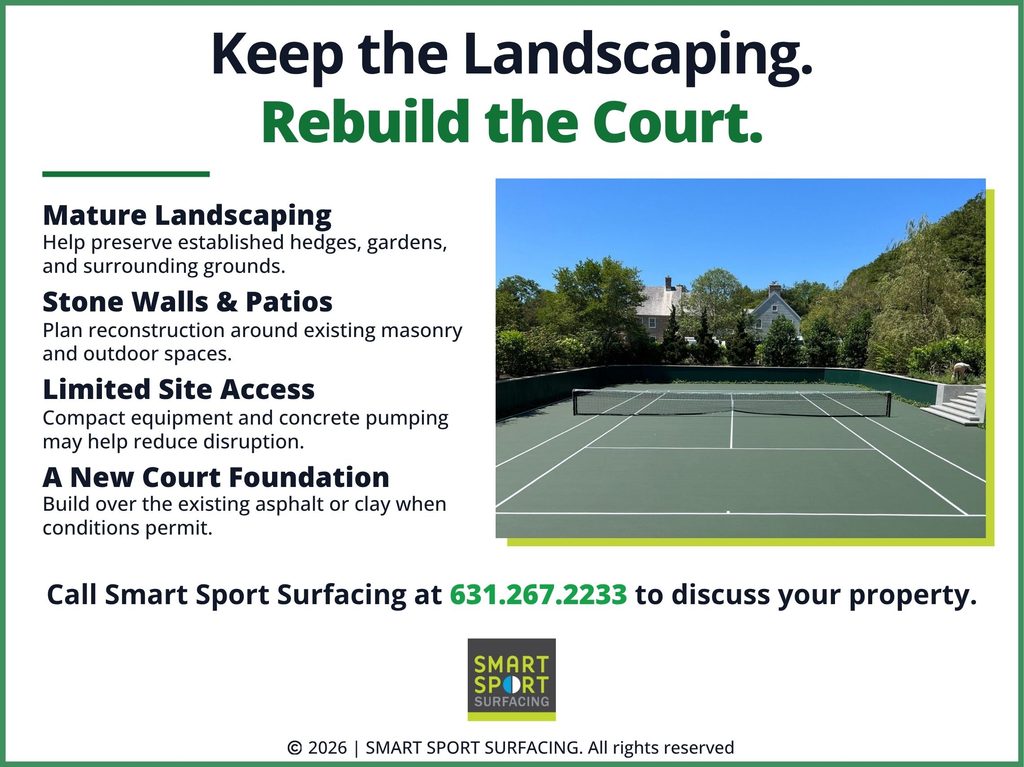
Picture an older, sunken tennis court on a Southampton property. Mature hedges line the perimeter. Stone retaining walls surround the playing area. A patio overlooks one end of the court, and the only access is through a landscaped section of the grounds.
Now consider what removing the original asphalt or clay might involve.
Getting heavy equipment down to the court could require constructing a temporary stone access road, excavating a route to the bottom of the retaining wall, and removing established plantings. Part of the wall will need to be saw-cut or opened so the old asphalt can be removed and new asphalt installed.
Afterward, the disrupted landscaping, access areas, and masonry would need to be restored.
That additional work can make removing and replacing the asphalt or clay significantly more expensive than constructing a new post-tensioned concrete slab directly over the existing court.
Our method avoids tearing out the old asphalt or clay in the first place.
We plan each reconstruction around the existing property, choosing equipment and concrete placement methods that avoid unnecessary disruption. Depending on access, compact equipment and concrete pumping can help deliver materials without opening a major route through established landscaping.
For homeowners with mature grounds, retaining walls, and carefully designed outdoor spaces, this is one of the most compelling advantages of rebuilding over the existing court.
What About the Gates, Fencing, Net Posts and Patio?
Gates, fencing, net posts, and patio transitions are familiar parts of our court-building work.
A new concrete slab raises the finished playing surface, so the surrounding features need to be set to the correct height for the new court. But those adjustments are normal parts of reconstruction planning.
A gate can be adjusted to suit the new elevation. Existing net-post sleeves can be extended where appropriate. Fencing can be modified or temporarily detached and reinstalled. If the transition from the court to an adjoining patio needs to change, a new patio section can be incorporated into the work.
We handle these adjustments as part of the overall court construction rather than as separate obstacles.
The result is a finished court designed to fit comfortably into the established property, with gates, fencing, net equipment, and adjacent spaces working together.
Why Choose Post-Tensioned Concrete for Tennis Court Reconstruction?
Leaving the old asphalt or clay in place is a major practical advantage. The new foundation is equally important.
Traditional asphalt tennis courts can develop cracks, depressions, and uneven areas as materials age and supporting conditions change. Clay courts require weekly maintenance to control weeds and moss. Surface coatings may improve an asphalt court’s appearance, but they cannot correct every underlying structural problem. A clay court requires yearly opening, weekly grooming, and season-ending closing; you cannot play pickleball or basketball.
Post-tensioned concrete offers a different foundation system.
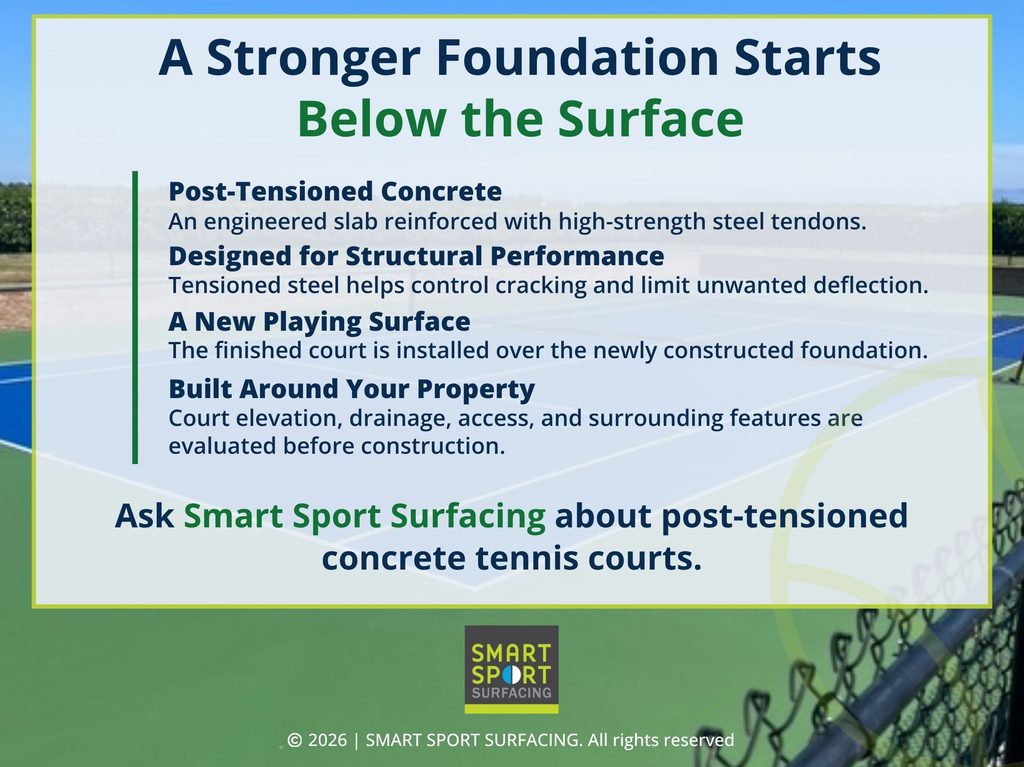
High-strength steel tendons are incorporated into the slab and tensioned to place the concrete under compression. This helps the slab resist tensile stresses, control cracking, and limit unwanted deflection.
The Post-Tensioning Institute recognizes these structural characteristics as important advantages of engineered post-tensioned slabs.
For tennis court construction, the goal is a strong, stable foundation supporting a consistent playing surface.
That’s why we place so much emphasis on the foundation when building post-tensioned concrete tennis courts. Rather than relying on repeated surface treatments to address an aging asphalt or clay court, we build a new engineered slab designed for long-term performance.
The Warranty Difference Matters, Too
Warranty coverage is another important distinction when comparing court construction methods.
In our experience, warranties for asphalt courts typically range from 1 to 5 years. We offer a 20-year warranty against cracking in the post-tensioned concrete slab.
That’s a meaningful difference for homeowners considering a substantial court reconstruction.
A Smart Approach for Established Hamptons Properties
Many residential tennis courts in East Hampton, Southampton, Water Mill and Bridgehampton occupy spaces that were carefully integrated into the surrounding property.
A court may sit below the lawn behind retaining walls. It may be bordered by gardens that have matured over decades, or connected to terraces and outdoor entertaining areas.
These are precisely the kinds of surroundings worth preserving when planning a tennis court renovation or substantial reconstruction.
We start with the court you have and what you want from the finished project.
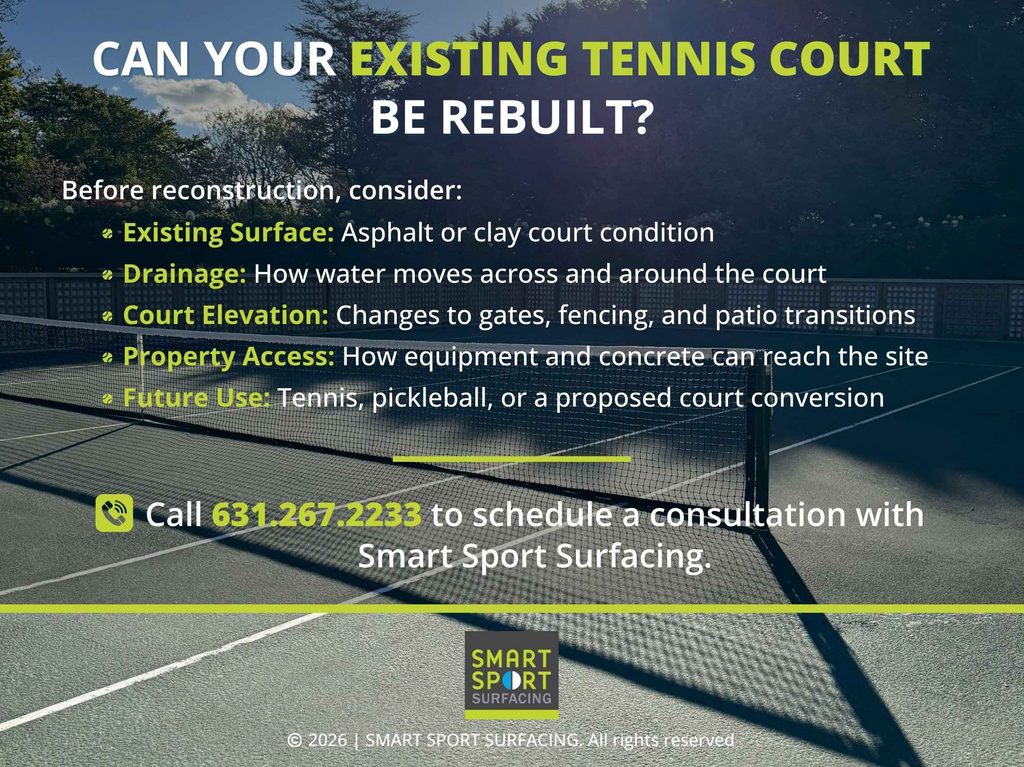
During a site review, we work through the proposed court elevation, how we’ll construct the new slab, how concrete and equipment will reach the work area, and which surrounding features we can adjust or retain.
Your Existing Court May Be the Starting Point for Something Better
If your asphalt or clay tennis court is showing its age or you want to enjoy pickleball and basketball, don’t assume the first step must be demolition.
A new post-tensioned concrete slab can often be installed directly over an existing asphalt or clay court. That opens the door to substantial reconstruction while avoiding the need to remove the old asphalt or clay and potentially preserving much of the landscaping, masonry, and other improvements around it.
Our work draws on decades of hands-on tennis court construction experience, with the new engineered foundation planned alongside the surrounding features of your Hamptons property.
Ready to give your existing tennis court a new foundation?
Call 631.267.2233 or contact us to arrange a consultation and find out how a new post-tensioned concrete court can be built on your property.